
What Does the Bible Say About Money and Why It Feels Uncomfortable
Jesus talks about money more than almost any other topic in the Gospels. He uses it in parables more frequently than any other subject. He weighs in on taxes, wages, debt, lending, and generosity with remarkable consistency. Yet many of us feel vaguely uncomfortable about this emphasis.
So we spiritualize it. We extract ethical principles. We create financial guidelines. Some of that has value, but in the process we often miss His point. Is Jesus building a financial rulebook? Establishing percentage guidelines? Applying pressure? Jesus is interested in something far more significant: what money reveals about the human soul and what it means to be truly free.
Table of Contents
What Does the Bible Say Money Reveals About Our Hearts
Jesus uses money more as a setting rather than a topic. He teaches through money because every human being navigates the terrain of wealth and resources. Money is universal, immediate, and personal. It reveals what we actually believe in ways that theory cannot.
Money is a particular kind of window and it is not neutral. When money appears in a conversation or a decision, it activates something: anxiety, hope, desire, fear, calculation. Our deepest convictions about God, about security, about what life is actually for, become visible in how we relate to what we have. They become visible not in what we claim to believe theologically, but in what we actually trust when real resources are at stake.
Jesus knows this about us. He makes money a frequent topic in His teaching because He is not interested in your financial strategy. He is interested in what your behavior with money reveals about what your heart is trusting in. He is teaching about freedom, not building a financial system.
This is why a person can affirm that God provides for all their needs and still experience paralyzing anxiety when money is at stake. Jesus cares about what you actually trust, not just what you claim to believe.
The Three Things Money Promises That Only God Can Deliver
There is a moment in Matthew when Jesus is tested in the wilderness. Satan places three things before Him: comfort, power, and pleasure. These are the three desires that almost everything human can be reduced to. They are the same three things money tends to activate in our lives.
Money promises comfort, the security of having what you need. Money promises power, control over your circumstances. Money promises pleasure, access to good experiences. Money does not actually deliver on these promises the way we expect it to, but it promises them. And that is what makes money spiritually significant.
When someone is driven by the desire for comfort, money becomes the solution. If I have enough, I will be secure. But the goalposts keep moving. When someone is driven by the need for power, money becomes a tool. But real power involves things money cannot purchase. When someone is driven by pleasure, money provides access. But pleasure pursued for its own sake produces emptiness. (See Ecclesiastes)
The problem is not money itself. The problem is when money becomes the answer to desires that only God was ever meant to fulfill. When money replaces God as the source of security, control, or deep satisfaction, something has gone wrong. That is the spiritual reality Jesus keeps pointing toward.
What Jesus Actually Said About Wealth and Spiritual Freedom
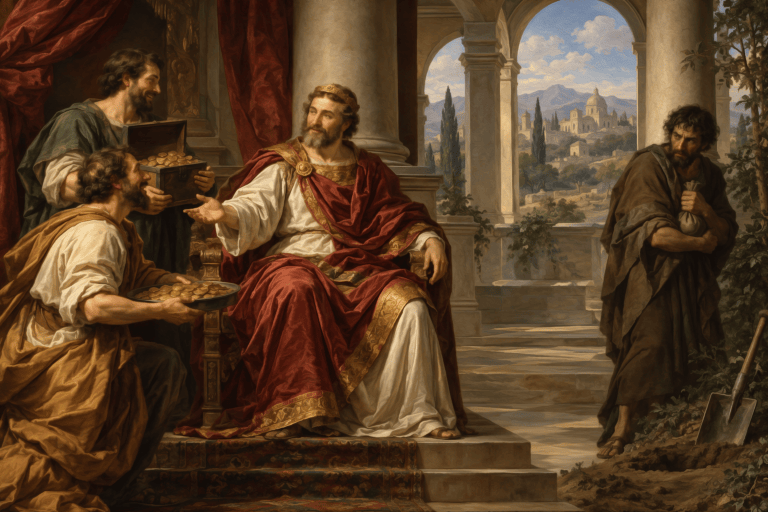
One of the most misread stories in the Gospels is the rich young ruler. A man comes to Jesus and asks what he must do to inherit eternal life. Jesus reviews the commandments. The man says he has kept them all. And then Jesus says: go, sell what you have, give it to the poor, and come follow me. The young man goes away sad because he has great wealth.
What is easy to miss is the detail that comes right before: Jesus looks at him and loves him.
This is not a story about rich people being evil. It is a story about Jesus seeing something in a particular person, the way his possessions had become the thing organizing his sense of security and identity, and offering him a way out. Not as judgment, but as an invitation. As compassion for someone whose soul was in bondage to what he had.
Jesus is inviting the young man toward a freedom he cannot access as long as he clings to his riches. And the young man chooses the familiar weight over the unknown freedom.
That invisible burden is not unique to the first century. For many people who have accumulated significant resources, there is a quiet pressure that comes with managing, protecting, and deciding about what they have built. It can look like security from the outside while feeling like anxiety from the inside. Jesus keeps returning to money because He is interested in our freedom. He sees what attachment does to us, and He offers something different.
What the Bible Says About Generosity and How It Forms You
There is a verse many of us learned early: “Where your treasure is, there your heart will be also.” We might expect Jesus to say that treasure follows your heart. Jesus uses a surprising word order to point to an overlooked truth about biblical generosity.
The direction of formation runs the other way. Where you put your treasure shapes who you become. Your giving is not merely an expression of what you already believe. It is forming what you believe. It is shaping your heart right now.
This is why decisions about generational impact and estate planning carry more weight than routine decisions about income. Those choices are powerful formative acts. Your highest values are embedded in those bigger decisions. They shape your heirs, your community, and your own soul.
We have seen this play out in real conversations at Cru Foundation. There is a clarity and a lightness that comes when someone aligns their wealth with their deepest convictions about God. People describe it differently. Some say it feels like relief. Others say it feels like peace. But something shifts when the direction of your resources matches the direction of your heart.
What the Bible Says About Tithing and Giving in the New Testament
One of the most interesting details in the Gospels is what Jesus does not say about money. He does not establish a tithe or give a percentage. He criticizes the Pharisees for tithing meticulously while missing weightier matters. He praises a widow for giving all she had.
This shift from Old Testament tithing to New Testament language is significant. Under the Old Covenant, the tithe was a law, a measurable, objective standard. The gospel is different. It is about whole-person reorientation. Not “am I giving enough?” but “what does stewardship of everything look like?” Not a percentage, but a posture that flows from what you genuinely believe about who really owns what you have.
(If you want to dive deeper into this shift, listen to The Smarter Generosity Podcast episode on what it looks like to hold your resources faithfully.)
This way is harder, you cannot just calculate and be done, but it is more freeing. You are not satisfying an external standard but rather answering a deeper question: given what I believe about God and what He has entrusted to me, how do I steward what is in my care? The answer might be far more than any fixed percentage. The question requires honest engagement with your bedrock beliefs.
The Questions That Matter
If Jesus keeps returning to money in His teaching, He is inviting us to notice something about ourselves. What does our relationship with money reveal about what we actually trust? What does our anxiety reveal about the source of our security? What does our giving reveal about what we believe belongs to us?
These are personal questions. They can sit unanswered for years while the financial planning moves forward around them. They deserve real space, real conversation, and a guide who is not in a hurry.
The good news is that awareness is the beginning of something. Once you can see what money is doing in your life, once you can notice the anxiety or the grip or the quiet resistance, you can begin to ask different questions. And the invitation underneath all of it is to leave guilt and walk in freedom.
What Jesus reveals is an essential truth: your ultimate satisfaction cannot be bought, and your security is never found in what you possess. When this conviction moves from a theological claim to a lived practice, your entire relationship with your wealth transforms. It unleashes a surprising generosity and enables you to hold everything you own with open hands. That liberated posture yields a profound peace that the tight grip of ownership can never deliver.
Frequently Asked Questions
What Does the Bible Say About Money in the Gospels?
Because money is a window into what we actually believe and trust. It reveals our deepest convictions about security, power, and what life is for. Jesus is not giving us a financial policy manual, He is paying attention to the state of our hearts, and money is one of the clearest places where the heart becomes visible.
Is the tithe still required for Christians?
esus never establishes a tithe in the New Testament. The gospel shifts from percentage to whole-person stewardship. The question is no longer “am I giving the minimum required?” but “what does faithful stewardship of everything look like?” The answer might involve giving far more than any fixed percentage. The shift is from “I have to give” to “I get to give.”
What does the story of the rich young ruler actually teach about wealth?
It is not about wealth being sinful. It is about what happens when attachment to what we have becomes the thing organizing our identity and security. Jesus looks at the young man with love and sees that his possessions have narrowed his vision. He invites him toward freedom, but the man chooses the familiar weight over the unknown freedom.
What does Luke 12:34 mean when it says “where your treasure is, there your heart will be also”?
The direction of formation is treasure first, heart following. Where you put your resources, your heart will go. Your giving is not merely expressing what you believe, it is forming who you are becoming. The practice shapes the person.
How do I know if my relationship with money is spiritually healthy?
Notice what happens when you think about your finances. Is there anxiety? Fear? Is your primary concern protecting what you have, or deploying what you have faithfully? Do you experience generosity as freedom or as loss? These are honest indicators of what money is doing in your life.
How can Christians approach financial planning in a way that is spiritually grounded?
Begin with the heart question: what do I believe about who owns what I have? What does faithful stewardship look like for me? Once those questions have been genuinely engaged, the practical conversation about tools and planning becomes an expression of what you believe, rather than a mere financial transaction.
What Happens When You Start to See It
If you find yourself wrestling with these questions of what you believe about money and resources, that wrestling is worth paying attention to. It may be the beginning of something. A Cru Foundation specialist can sit with you and help you think through what faithful stewardship looks like for your specific situation. There is no agenda, and we will never tell you where to give or how much to give. We are here to help you think clearly about what God has entrusted to you, and what faithfulness looks like in response.
You can reach our team at crufoundation.org/contact, by email at hello@crufoundation.org,
or by calling 800-449-5454.
*The content on this page is for educational and informational purposes only. It does not constitute legal, tax, or financial advice. Please consult with qualified professional advisors regarding your specific situation before making any giving or planning decisions. AI tools were used as assistance in the creation of this content.