

What is Smarter Generosity? What It Means to Hold Resources Faithfully
The Heart Question at the Center of Christian Stewardship
You are sitting across the table from your financial advisor, or maybe at the kitchen table with your spouse. The spreadsheet is open, and the numbers are clear. The year has been good! The accounts have grown! The giving column shows the same pattern it has shown for decades: tithe, annual gift, a few surprise needs along the way. And yet you find yourself staring at the page with a feeling that something is missing.
The question is rarely about how much. Most believers who have walked faithfully with their resources for years have settled that. The question running underneath is more personal, more searching. It sounds like this: What is all of this actually for? Is my giving what it should be? And if everything I have truly belongs to Him, what would it look like to steward it with the kind of clarity and purpose I bring to every other area of my life?
The ministry of Cru Foundation is made to bring gospel light into those hidden places of the heart.
Table of Contents
The Conversation Christian Donors Are Already Having
For nearly fifty years, Cru Foundation has walked alongside believers who carry this kind of quiet weight. They are people of real faith, genuine generosity, and growing resources. Many of them have already given sacrificially to their church, to Cru missionaries they love, and to causes that move their hearts. They are already doing well and they sense there may be more.
Eric Fleshood, who leads Cru Foundation, describes it as the difference between giving out of habit and giving out of a deepening awareness of what God is doing in and through you. One is faithful. Both are good. But the second requires a different kind of conversation, one that begins before the strategy and before the tools, in the space where purpose and conviction take shape.
This is the conversation The Smarter Generosity Podcast was created to hold.
The podcast is built around a simple conviction: generosity is part of discipleship. It is one of the places where our theology of God’s ownership meets Tuesday morning, where what we believe about the Kingdom runs up against the specifics of a brokerage account. When we bring clarity and prayer and good counsel into that space, giving becomes less anxious and more free. It comes from a fuller heart guided by smarter choices, which is to say, more aligned with the Giver who entrusts us with it all.
What Faithful Stewardship Looks Like When It Gets Personal
Most of us can affirm the theology that God owns everything. We are stewards. Psalm 24:1 comes quickly to mind: “The earth is the Lord’s, and everything in it.” We know the parable of the talents. We have heard sermons on the widow’s mite. The theology is not the difficult part. The difficult part is the Tuesday morning part, where a growing portfolio or an appreciated stock or a family business creates questions that sermons alone do not answer.
Cru Foundation was built to serve people in that exact place. The work has always been relational. It starts with listening: What has God placed in your hands? What are the convictions that shape your giving? Where do you feel uncertain? The team brings wisdom in areas like donor-advised funds, appreciated assets, and estate design, but the tools always follow the conversation. They never lead it.
For development officers and ministry leaders who walk with ministry partners every day, this matters. You know the people in your life who carry this quiet weight. You see them wrestling with questions about lasting impact, how to give wisely in a changing financial landscape, and what it means to be generous with resources that keep growing. The Smarter Generosity Podcast was designed as a resource you can share with them, a trusted voice that meets them inside the question rather than pushing toward a predetermined answer.
Where Biblical Stewardship Meets Real Life
Scripture treats stewardship as a relationship, not a formula. In Matthew 25, the master entrusts each servant “according to his ability,” and the invitation at the end is personal: “Come and share your master’s happiness.” The language is relational. It is the language of trust, of togetherness, and of delight.
That relational quality is what separates biblical stewardship from financial planning. Financial planning asks, “What is the most efficient way to deploy these resources?” Faithful stewardship starts with a prior question: “Who gave me these resources, and what does He have in mind?” Both questions have value. But the order matters. When stewardship leads, the planning serves something larger.
Cru Foundation exists at the intersection of two great mandates in Scripture. The first is the Genesis mandate: the call to exercise dominion, to cultivate and steward creation for flourishing. The second is the Great Commission: the call to make disciples of all nations. Where those two callings meet, you find believers who want to live well and give well, who want their financial life to reflect the same Kingdom convictions that shape their prayer life and their family life. This is the territory of biblical stewardship, the long Christian tradition that runs underneath everything The Smarter Generosity Podcast was built to explore.
Every episode explores a real question that donors, ministry leaders, and advisors carry, a question that sits at the place where faith and finances meet. The conversations are honest, reflective, and grounded in the belief that God’s people can bring both wisdom and worship to the way they steward what He has provided.
Frequently Asked Questions About Faithful Stewardship
What is the difference between giving and biblical stewardship?
Giving is one expression of stewardship, but stewardship is the larger concept. Biblical stewardship is the recognition that everything we have belongs to God and that we are entrusted with managing it for His purposes. Giving flows from that conviction, but so does how we earn, save, invest, and plan. When we begin with stewardship as a way of life, giving becomes less of an obligation and more of a response to what God is already doing.
How does Cru Foundation help donors think about Christian generosity?
Cru Foundation begins with listening. Before any conversation about tools or strategies, the team wants to understand your convictions, your family, and the things God has placed on your heart. From there, the Foundation can help bring clarity to decisions around giving, whether that involves a donor-advised fund, appreciated assets, estate design, or simply thinking through what faithful generosity looks like in your current season. The goal is always wisdom and peace, not pressure.
What is smarter generosity?
Smarter generosity is giving that reflects both faith and wisdom. It means bringing the same intentionality to your stewardship that you bring to your work, your family, and your spiritual life. It can involve practical tools like tax-advantaged giving strategies, but it always starts with purpose. Cru Foundation’s mission is to accelerate the Great Commission through smarter generosity, helping believers align their resources with what God is doing in the world.
How is Cru Foundation different from other charitable giving organizations?
Cru Foundation shares your biblical values. The team will never tell you where to give or how much. For nearly fifty years, the Foundation has served Cru ministry partners with strategic giving counsel and practical wisdom, all grounded in the conviction that stewardship is part of discipleship. There is no ongoing administrative fee on the Great Commission Donor Advised Fund, and every conversation begins with your story, your goals, and your calling.
Can Cru Foundation help with estate planning and legacy giving?
Cru Foundation offers complimentary estate design services that help you think through how your resources can reflect your values across generations. The process begins with the deeper questions: What kind of legacy do you want to leave? What do you want your family to carry forward? From there, the team can help you explore options and connect with the right professional advisors. The Foundation does not provide legal or tax advice, but it can serve as a trusted guide alongside those who do.
What does faithful stewardship look like for Christian donors today?
Faithful stewardship is the slow work of bringing your resources, your convictions, and your decisions into alignment with what God is doing. For some it means a more intentional giving plan. For others it means tools like a donor-advised fund or estate design that match generosity to the season of life. The shape changes. The posture stays the same: stewardship as part of discipleship, not separate from it.
Where Faithful Stewardship Becomes a Conversation
If you have listened to this first episode, you may have recognized your own experience in the conversation. The feeling of faithfulness mixed with a desire for more clarity. The awareness that your resources have grown and your stewardship questions have grown with them. The longing for a trusted voice that will slow down with you and help you think, rather than rushing toward a product or a pitch.
If stewardship questions are becoming more pressing for you, a member of the Cru Foundation team would welcome the chance to listen. No agenda, no obligation, just a conversation. You can start that conversation at crufoundation.org/contact. You can also reach the team at hello@crufoundation.org, or call 800-449-5454.
*The content on this page is for educational and informational purposes only. It does not constitute legal, tax, or financial advice. Please consult with qualified professional advisors regarding your specific situation before making any giving or planning decisions. AI tools were used as assistance in the creation of this content.
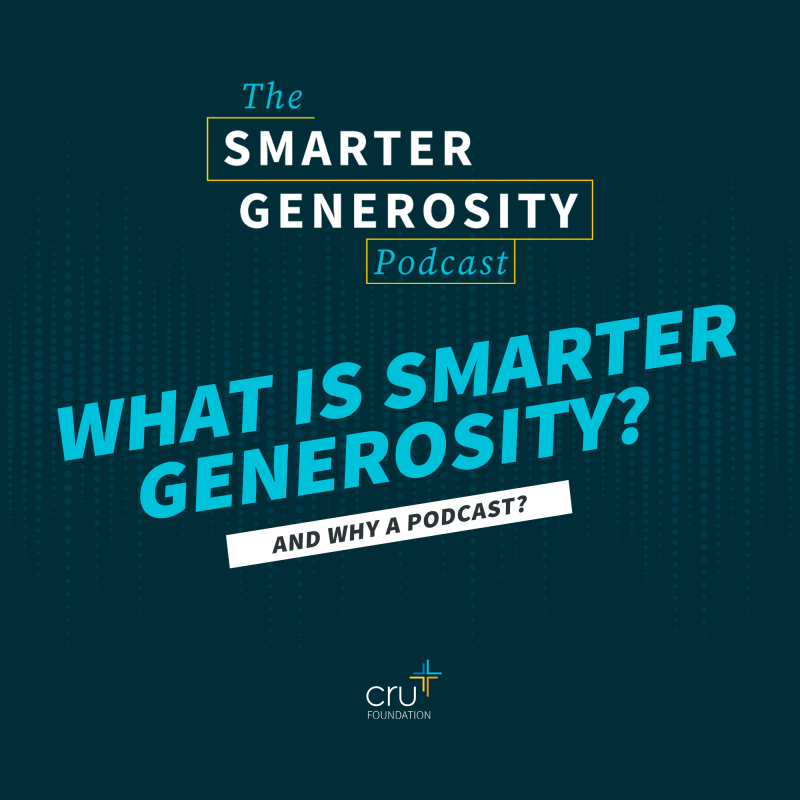
Smarter Generosity: Why We’re Having This Conversation
Katie Brubaker: Welcome to the Smarter Generosity podcast. I’m Katie Brubaker.
Eric Fleshood: And I’m Eric Fleshood.
Katie: Today we’re going to talk about why we’re doing a podcast. It seems like a good place to start. Eric, let’s start with the name. What do you mean by smarter generosity?
Eric: The Smarter Generosity name comes from the mission statement of Cru Foundation, where we say we’re here to help accelerate the Great Commission through smarter generosity. We thought that would be a great name for our podcast.
We’re trying to bring together two things that can sometimes be difficult to bring together. Let’s start with generosity. I think most people understand what that means. It’s a heart-oriented posture of wanting to give yourself away, live with abandon, live for others, and share with others. When it comes to charitable giving, that’s certainly the heartbeat of Scripture when it comes to participating in God’s kingdom.
So generosity is pretty straightforward. We say smarter generosity because, as Christian stewards in the United States, there are opportunities available to us to make our giving more effective. There are more and less efficient ways to be generous, ways to make the most of your giving dollars and help them go as far as they can, often by leveraging provisions in the tax code.
If we can bring together the head and the heart, that’s what we’re trying to do here.
Katie: So we’ve got the smarter, which is the head, and the heart with generosity. Like you said, there are good ways to be generous, but there are also better ways to be generous. I think that’s at the heart of this podcast.
You touched on something else. You said that smarter generosity is part of the mission statement of Cru Foundation. Could you give us a flyover? What is Cru Foundation?
Eric: Cru Foundation is a ministry of Campus Crusade for Christ, also known as Cru in the United States. It was started by Bill Bright in 1972 with the express purpose of helping to fulfill the Great Commission. There was a recognition that people might have an asset or a complicated giving situation that a foundation could facilitate more easily than traditional methods at the time.
Cru Foundation has operated continuously since then. Today, we are a full-service public foundation connected to Cru, in service to the Lord and the fulfillment of the Great Commission. We help people unleash the full potential of their giving for the benefit of the body of Christ.
Katie: Going back to what you said about generosity, I know that when people call or interact with the foundation, we often hear something like, “I know generosity matters. It’s important in my life, but I don’t always know how to connect it all.”
They may not know how it fits into their lives, what it looks like for their families or their kids. How would you respond to somebody who says, “I know generosity matters, but I don’t always know how it fits into my life”?
Eric: God’s wired me a certain way, and I try to think about things as an integrated whole. What I find in my life is that it’s easy to take different parts of the Christian life and treat them like compartments.
Sometimes that’s how we think about generosity. It’s one aspect of my Christian life that I need to figure out, just like I need to figure out how to pray more or how to disciple others.
But as I’ve grown, I’ve realized generosity really could be a definition of the authentic Christian life, a mark of the true Christian.
Think for a moment about the fruit of the Spirit in Galatians chapter 5: love, joy, peace, patience, kindness, gentleness, and self-control. My understanding is that, in the Greek, Paul isn’t unpacking separate things so much as different aspects of one thing. The fruit of the Spirit has many facets.
While generosity isn’t mentioned specifically in that list, I dare you to find someone who exhibits the fruit of the Spirit who isn’t one of the most generous people you’ve ever met.
I think generosity, at its heart, is an overflow of someone who’s really connecting with the gospel, with Jesus, and who’s filled with the Spirit. It’s a natural outflow of that. So when people say, “I don’t know how to incorporate this into my life,” perhaps the starting point is going back to Christ.
Katie: What do you mean when you say the starting point is going back to Christ?
Let me give you some context for why I asked that. I was laughing when you started talking about how generosity can be siloed in our lives. It’s like, “Pray more. Check. Did I read my Bible today? Check. Am I giving a tithe? Check.”
I felt convicted because, just this morning, I was thinking about my two teenagers, who are going to have summer jobs. I was thinking through budgets and how we’re teaching fiscal responsibility. I thought, “We really need to incorporate giving so they can start exercising that muscle.”
But that’s a great example of how we normally think about it. Giving is one item in the budget, one more thing to do, rather than part of a whole life of stewardship as a Christian.
With that background, what do you mean when you connect generosity with going back to Christ and living as an integrated whole?
Eric: Certainly there’s an aspect of giving that’s a discipline. But what I’m trying to get at is that generosity isn’t so much something you do as it is something you are. It’s a character trait. It’s a mark of the soul and the spirit.
It’s the overflow of your relationship with the most generous, wonderful person in the universe. As you get to know Him and see His generosity toward you, you can’t help but become more generous yourself.
Katie: I will push back a little because I know plenty of non-Christians who are very generous. How does that work together?
Even if I weren’t a believer, I think I would probably still have a generous bent. Maybe part of your answer is that, as you know Christ, generosity gets woven more deeply into the fabric of your life. But I do know a lot of generous people who aren’t believers. How does that fit?
Eric: You’re absolutely right. We Christians certainly don’t have the market cornered on goodness in this world. Our friends and neighbors who aren’t Christ followers are capable of being some of the most generous people you can know.
Perhaps it goes back to the source of that generosity. Why are you generous? Where does the energy for that come from? Does it come from something manufactured, or from a belief system that isn’t true?
Generosity is still good. But in the end, we want our generosity to be connected to the truth. For those of us who are Christ followers, that means the overflow of the truth of Jesus.
Katie: I like what you said earlier, that generosity can be a discipline. As people practice it over time, that’s also where formation happens.
I want to pivot a little and look ahead to what we’re going to discuss on this podcast. I think we’ll talk a lot about stewardship and how generosity and stewardship work together.
What do you see happen in someone when they begin to think of themselves more as a steward instead of an owner?
Eric: There’s a lot of freedom that comes from making the transition from an ownership mentality to a stewardship mentality.
A steward has responsibility, but not the ultimate responsibility that an owner has. God is the owner of everything. When we realize we’re put on this earth to be managers, to be stewards of what He’s entrusted to us, there’s a sense in which the pressure is off. There’s only so much we can control as managers and stewards.
Adam and Eve realized that in the garden, sadly, when they went from being managers with all kinds of freedom, naked and without shame, to embracing an ownership narrative. They reached out and grabbed what wasn’t theirs. They decided that was a better path to glory and power and love and intimacy.
Katie: And it was expressly forbidden.
Eric: Yes, and they found out quickly that operating from an ownership mentality brought curses and woes that we’re all still working through today.
Katie: So that stewardship mentality around generosity is part of what we do at Cru Foundation. It’s more than practical knowledge. Interwoven with it is this movement from an ownership mentality to a stewardship mentality.
I’d say that’s one of the foundational aspects of what we do at the foundation. Would you agree or expand on that?
Eric: Certainly. That’s what we want to be about, and the things we do at the foundation support and underscore that perspective in people’s lives.
A lot of times people come in, and we start talking about charitable giving tools. It’s amazing how many of the solutions depend on your ability to distinguish between ownership and control, or ownership and use.
If you think ownership is the goal, it can actually get in the way of maximizing God’s resources for His purposes. But if you realize that your goal as a steward is to make sure God’s things are used for God’s purposes to the greatest extent possible, that changes things.
A simple example is someone realizing that, instead of giving cash to a favorite ministry, they could give appreciated stock. That might be better for their cash flow, and it could offer two tax advantages.
Depending on their circumstances, they may be eligible for a charitable deduction based on the value of the donated stock. And by transferring appreciated stock directly to an eligible charity rather than selling it first, they may avoid realizing the capital gain themselves. The charity generally doesn’t pay capital gains tax when it sells donated stock.
So ownership transfers from the donor to the charity, but the donor can still have influence over where those charitable resources are directed.
On the other hand, if a donor insists on holding on to ownership and sells the stock first to give away the proceeds, they may realize capital gains tax. That means a portion of the value may go toward taxes instead of charitable purposes. They’ve potentially lost an opportunity to steward those funds toward the cause they wanted to support.
Katie: When you say ownership, I think of control. I don’t know if I’m equating those exactly the way you mean, but I think of being open-handed. When you truly realize and believe that the Lord owns it all, what does that look like in your life when it comes to generosity and stewardship?
I’ll admit I’m guilty of looking toward the practical side of generosity: What are the tools? How do we make this happen?
I have to be careful to return to a more holistic way of thinking about stewardship because I tend to focus on getting things done. If somebody listening has a similar bent and realizes, “I mostly think about generosity in practical terms,” where do they begin rethinking their relationship to generosity?
Eric: I can certainly appreciate that. A lot of what we talk about at Cru Foundation is tools and techniques, but that can miss the heart of it.
What we’ve learned at Cru Foundation is that about 80 percent of the conversation should center on the why. What’s it for? What is God’s purpose for me in this?
Because that’s where life is. That’s where the fun is. That’s where vision, heart, and becoming more Christlike come into the equation.
Once that’s in place, the how-to conversation becomes a lot easier. I find people have a lot more energy to get the how-to done.
Katie: That really is where the fun is. I’ve said to people when I’m working through different gifts, “If we’re not having fun doing this, I feel like I’m doing it wrong,” because it is joyful.
I’m glad you said that. It really is a lot of fun.
If someone takes only one thing from this conversation, Eric, what would you want it to be?
Eric: I’d like to invite people to join us in this conversation of learning and growing, pursuing Christ, and trusting Him to form our hearts in a way that prepares us for the kingdom we’re inheriting, and to begin living into it right now.
One of the ways that’s expressed most often in our lives today is through what we do with our money and possessions.
Stewardship is another way of expressing our dominion. How are we exercising the cultural mandate in Genesis 1 over the things God has given us, for His glory, His honor, and His purposes?
As we learn how to do that better, we’ll see our hearts and character grow to reflect more of the goodness of Jesus.
Katie: Amen. I think that’s a great place to end. Thanks for your wisdom.
Eric: Thanks for being here today, Katie. I hope we get to talk again.
Katie: Let’s do this again.
Eric: All right, that’s a deal.
This transcript has been lightly edited for clarity and readability. The conversation has been preserved, with verbal fillers, repetitions, and recording artifacts removed.
This content is provided for educational purposes only and should not be considered legal or tax advice. Please consult your professional advisor regarding your specific situation.