Charitable Remainder Trust
A giving option that may provide income now and a future gift for ministry.
A charitable remainder trust is a charitable giving arrangement that can provide payments to you or other beneficiaries for a period of time, with the remaining assets later supporting the Cru ministries or missionaries you choose.
Charitable remainder trusts can be structured in different ways. Some provide a fixed payment amount, often called a charitable remainder annuity trust. Others provide payments based on a percentage of the trust’s value, often called a charitable remainder unitrust. Each structure serves a different purpose, which is why it is important to begin with the deeper question: What are you trying to accomplish as a steward?
Cru Foundation can help you think through that question. In certain situations, Cru Foundation may be able to serve as trustee, help oversee the trust assets and coordinate legal, accounting and administrative matters. When the trust term ends, the remaining assets are distributed to support the Cru ministry or missionary work you designated.

Providing for your family. Funding ministry. Thinking carefully about both.
Many Christian families hold appreciated assets and eventually face a difficult set of questions. Selling the asset may create tax consequences. Giving the full asset away may remove income the family still needs. Holding it indefinitely may delay the decision without bringing clarity.
A charitable remainder trust may be helpful in this kind of situation. The trust receives the asset, provides payments to you or other beneficiaries for a period of time, and then distributes what remains to the ministry purposes you chose. For some donors, this can be a thoughtful way to consider family income needs, appreciated assets, and future kingdom impact together.
A charitable remainder trust is not the right fit for every family. But for some, it offers a way to move forward with greater clarity.
Evaluate Your Goals
A charitable remainder trust may be worth exploring when your goals include:
Avoiding the capital gains taxes associated with the sale of an asset.
Converting low-income-producing assets into a larger lifetime income stream.
Moving an asset (discounted) and the associated income to another generation.
Partial gifts of an undivided interest in which the charitable tax deduction
from the gift portion will offset a major portion of the taxes on the sale of
the retained portion.
Providing a significant gift to Cru or your other favorite charities.
Families who consider this kind of plan usually share a few things in common.
- They are holding a significantly appreciated asset and have decided to part with it in some form.
- They want or need income from the proceeds, often for both spouses across their lifetimes.
- They have a clear ministry purpose in mind. The trust funds it at the end of the term.
- They are ready to make an irrevocable decision and want to make it carefully, with biblical counsel.
If those describe where your family is, a charitable remainder trust is worth a conversation with a specialist from our team.


How Does a Charitable Remainder Trust Work?
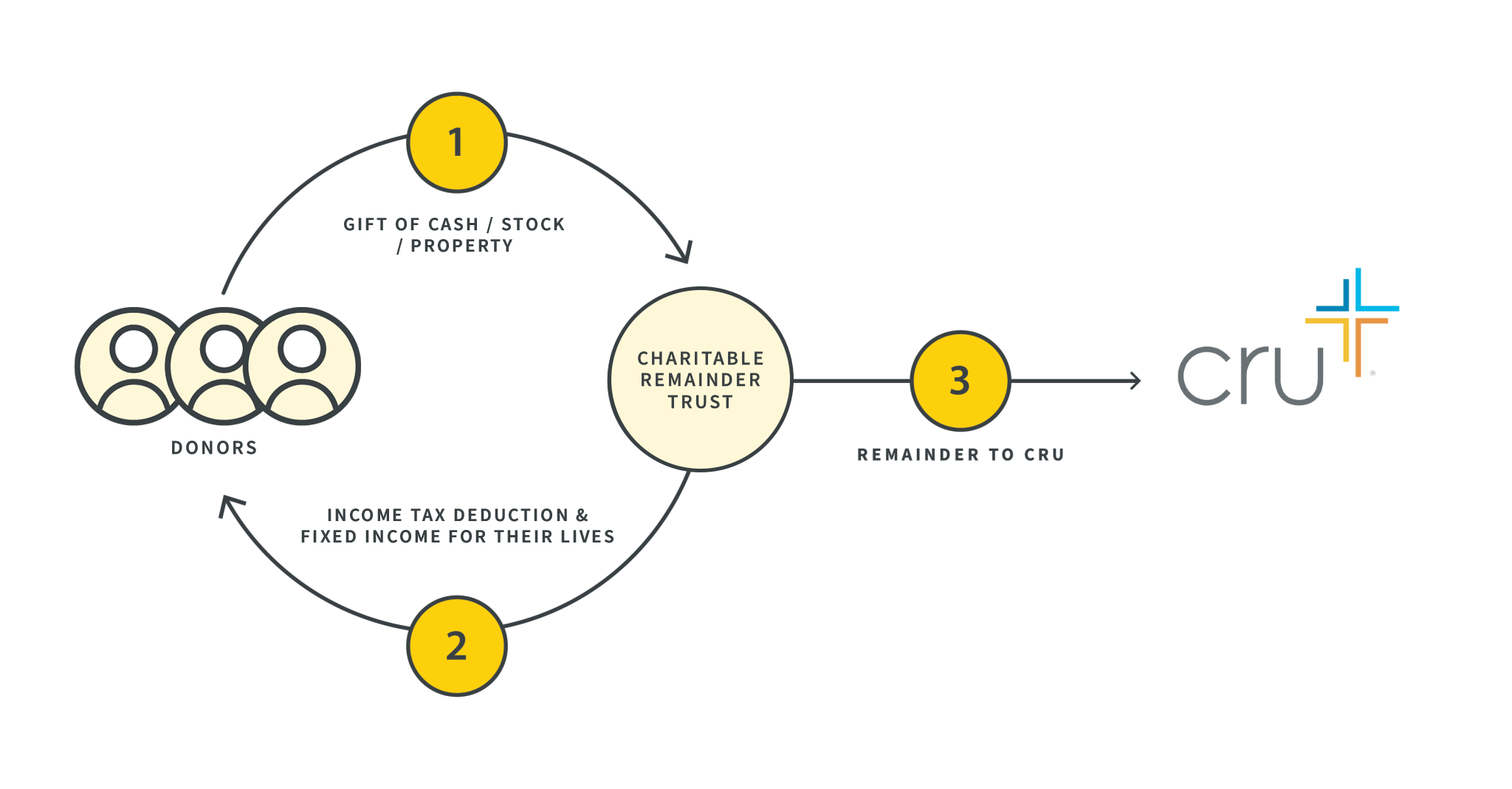
To get started, Cru Foundation can help you clarify your giving objectives and understand whether a charitable remainder trust fits your broader stewardship goals. Once you and your professional advisors decide to move forward, the process generally works like this:
Transfer property or undivided interest in a portion of the property to the trust.
Receive an immediate income tax charitable deduction and an income for the lifetime(s) of the income beneficiary(ies).
After the obligations of the trust to the income beneficiaries are fulfilled, the remaining principal will be distributed to your designated Cru ministry or missionary.
Trustee converts the assets to cash and reinvests proceeds to pay an annual income for the lifetime(s) of the income beneficiary(ies).
After the obligations of the trust to the income beneficiaries are fulfilled, the remaining principal will be distributed to your designated Cru ministry or missionary.
Determine financial, estate and gift objectives and an attorney drafts the trust(s).
Transfer property or undivided interest in a portion of the property to the trust(s)
Receive an immediate income tax charitable deduction.
Trustee converts the assets to cash and reinvests proceeds to pay an annual income for the lifetime(s) of the income beneficiary(ies).
After the obligations of the trust to the income beneficiaries are fulfilled, the remaining principal will be distributed to your designated Cru ministry or missionary.
Depending on the custodian, they will either send the QCD check directly to Cru, send the check to the IRA account holder but made payable to Cru, or they may provide the IRA account holder with a checkbook with which to make a QCD. Whichever method, please notify Cru of your gift and your desired intentions.
What Cru Foundation does from start to finish.
Start with your "why"
Before any structure, we listen to what your family is trying to accomplish — for your income, for your heirs, for the ministry purposes God has put on your heart.
Weigh the options together
A charitable remainder trust is one tool among several. We help you understand how it compares to a donor advised fund, a charitable gift annuity, or a direct gift, and which combination fits your family best.
Serve as trustee
In many situations, Cru Foundation can serve as trustee, direct the investment of the trust assets, and oversee the legal, accounting, and administrative matters at no additional cost.
Talk it through with a specialist.
A charitable remainder trust is a significant, irrevocable decision. It deserves careful thought before any documents are drafted.
Schedule a no-obligation conversation with a Cru Foundation specialist. We will listen to your situation, help you understand the options and consider whether a CRT may fit your family’s goals. There is no pressure to move forward.Schedule a no-obligation conversation with a Cru Foundation specialist. We will listen to your situation, walk you through your options, and help you understand whether a CRT fits your family. There is no pressure to move forward.
Fill out the form to get started.
You can also call (800) 449-5454 OR email us at hello@crufoundation.org