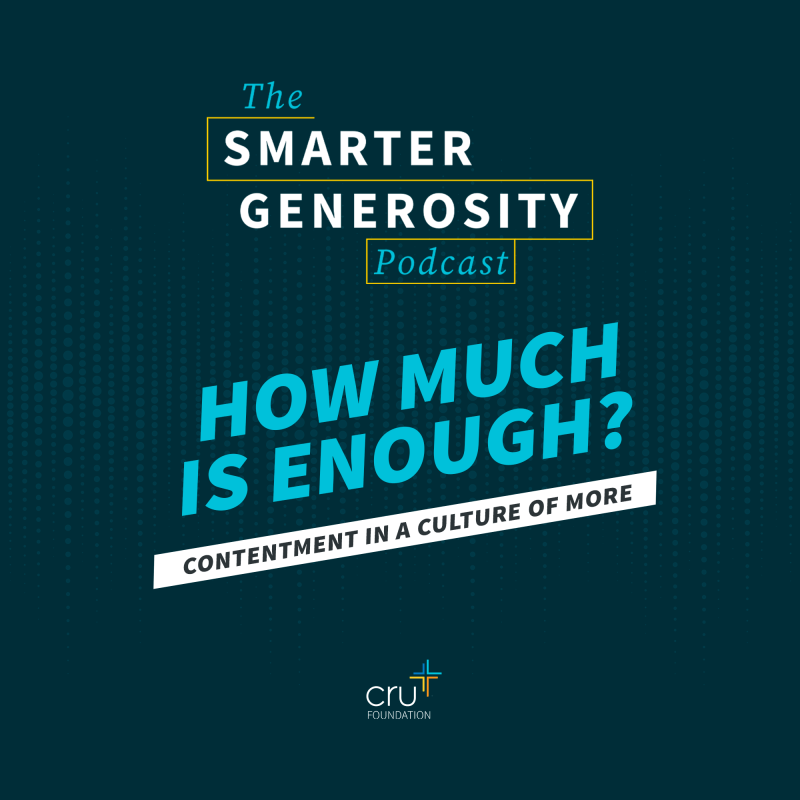


How Much Is Enough? Contentment In A Culture of More
Before deciding how much to give, save, or leave behind, it helps to answer a more personal question: What does enough look like for the life God has given you to steward?
There are plenty of financial questions someone else can help you answer. A financial planner can run a retirement projection. An attorney can help structure an estate. An advisor can explain what different choices may mean for your family.
Then there is the question very few people ask: How much is enough?
That question tends to come up when families begin making decisions about what they will leave their children or how much they might give away. Those are important conversations, but they depend on something more basic. Before deciding what goes to someone else, we need some understanding of what our own life requires.
Put more practically: What does a year of your life cost?
Not someone else’s life or the life you want to be able to afford. But what does it cost to live the life you believe God has given you to live?
Once that number is established, it would be easy to say that everything above that amount should go to charity. Scripture does not give us that formula either.
Generosity is larger than tax-deductible giving.
There may be a neighbor who needs help. A family member may need care. Resources might remain in a business that provides meaningful work for employees and their families. There are ways to use money faithfully that will never appear on a charitable receipt.
So the question isn’t simply, How much can I give away?
It is, What does God want done with what He has entrusted to me?
That keeps generosity connected to stewardship. Giving is one expression of a life that has stopped treating ownership as the final goal.
Table of Contents
Nobody can tell you how much money is enough
It would be convenient if Scripture gave Christians a percentage or a dollar amount and settled the issue for everybody. It doesn’t.
There is no biblical income level at which a believer officially has enough. There is no universal lifestyle cap, no required size of house, and no formula that tells one family how much is appropriate to keep while another family gives more away.
That is part of what makes the question so powerful; it requires discernment rather than comparison.
A household with significant responsibilities may need more than another household. One family may believe God has given them freedom to live on considerably less than they earn. Another may have responsibilities, relationships, or opportunities that make a larger home or a different level of spending appropriate. A home used regularly for hospitality, for example, is doing something different from a home chosen simply because more was available.
The point is not to make one of those choices more spiritual than the other. The work is asking the question honestly before the Lord rather than allowing income, culture, or habit to answer it for us.
Contentment means knowing what is enough
Our culture is very good at helping us decide what we want next. There is always another upgrade, another experience, another level of comfort, another number that promises to make us feel secure.
None of that requires us to be especially materialistic. We can love God, give generously, and still allow our definition of enough to move a little farther away every time our resources increase.
That is one reason biblical contentment deserves more thought than simply learning to be happy with whatever happens to be in the bank. Contentment asks us to recognize what we have received and to resist the assumption that more must always become ours to use.
Without some sense of enough, every increase can quietly become a new necessity. A raise changes the monthly spending. A successful investment changes the standard of living. A larger balance changes what feels safe. The finish line keeps moving because we never decided where it was.
Naming enough gives us a way to notice when that is happening.
One year
One practical way to begin is to look at a year rather than at everything you own.
What does it take to live your household’s life for a year? What does housing cost? What does it take to care for the people for whom you are responsible? What does your family spend, save, enjoy, and use in the ordinary course of life?
Then comes the more important part: Does that picture reflect the life you believe God has called you to live as His steward?
This is where the question moves beyond budgeting. A budget tells us where money has gone. Stewardship asks why we are using it that way.
Some expenses support responsibilities God has clearly given us. Others may have become normal simply because we could afford them. Some resources create opportunities to serve, gather people, care for family, or do work we believe matters. Other spending may deserve another look.
The point isn’t to squeeze a life down to the smallest possible number. Enough is not the same as bare minimum. It is an attempt to describe a faithful life in real terms.
Once we begin doing that, an abstract question about wealth becomes much more concrete.
A number can be a guardrail without becoming a formula
There is a danger in turning this exercise into another rule.
You might calculate what a year costs today and discover five years from now that the number has changed. Your health may change. Family responsibilities may change. God may give you opportunities you could not have anticipated. The future contains real uncertainty.
Naming enough doesn’t remove any of that.
It gives us a guardrail, not a box to squeeze our budget into year after year.
The purpose is not to discover the one number God has hidden somewhere and never alter it again. It is to become more intentional about what we need so that every financial decision is not automatically governed by the possibility of having more.
That can be freeing. If I have never considered enough, there is no clear point at which additional resources become available for another purpose. Everything remains potentially mine to consume, save, or protect.
Stewardship introduces a different posture. God is the Owner. I am responsible for what He has entrusted to me. That means I can ask what my responsibilities require while remaining open to what He may want done with the rest.
What comes after enough?
Once a family has some understanding of what enough looks like, several other questions become easier to see.
- How much do we need to save?
- What do we want to leave our children?
- What kinds of future needs are we preparing for?
- How much are we free to give?
- What opportunities might God place in front of us?
Those questions still require wisdom. Naming enough does not automatically answer them. It simply puts them in a better order.
This also keeps generosity from becoming a percentage that allows us to avoid the larger conversation. A family can follow a regular giving practice faithfully for years and still never consider whether its growing lifestyle is using everything else by default.
The deeper formation happens when we begin asking what all of it is for.
Proverbs gives us a prayer, not a number
Proverbs 30 gives language to the tension:
“Give me neither poverty nor riches; feed me with the food that is needful for me, lest I be full and deny you and say, ‘Who is the LORD?’ or lest I be poor and steal and profane the name of my God.”
(Proverbs 30:8-9, ESV)
The prayer does not ask for the most possible, nor does it romanticize having too little.
The writer recognizes danger on both sides. Need can consume our attention. Abundance can make us feel as though we have no need of God at all. His prayer is for what is needful, received in a life that remains dependent on the Lord.
That is a helpful picture of contentment because it gives us a range rather than pretending everybody belongs at the same number.
The question still has to become personal. What do you need for the responsibilities and life God has given you? Where has comfort quietly become expectation? Where is fear and insecurity asking you to hold more than you need? Where has generosity already made you more aware of God’s provision?
Those are questions worth returning to over time.
Enough can become a practice
Figuring out how much is enough may not happen in one conversation. It may take time with your spouse, your Bible, and the people who help you think wisely about your finances.
That process itself can be formational.
It makes us pay attention to our desires. It exposes fears we may have disguised as prudence. It gives us a chance to talk with our children about what money is for. It can help a husband and wife discover that they have been carrying different definitions of security without realizing it.
And it gives generosity a place to grow from something we do into something that shapes how we see everything God has entrusted to us.
You do not need a perfect number to begin. You need enough clarity to have an honest conversation.
- What does a year of your life cost?
- What responsibilities has God given you?
- What is enough for those responsibilities to be carried faithfully?
- And if He has entrusted more than that to you, what might He want to do through it?
Those questions will not produce the same answer in every home. But they can help each household begin recognizing when enough really is enough.
Frequently Asked Questions
At what point is enough money enough?
There is no universal dollar amount that defines enough for every person or household. A useful place to begin is by understanding what a year of your life costs and considering whether that reflects the responsibilities and lifestyle you believe God has given you to steward. The goal is to develop enough clarity that “more” no longer becomes the automatic answer.
Is $[fill in the blank] a lot of money to have?
The number by itself says very little. Its meaning depends on a household’s needs, responsibilities, stage of life, and the period that money needs to cover. Rather than deciding whether a particular amount is universally large or small, it can be more useful to compare it with what your own life requires and the purposes for which those resources have been entrusted to you.
What does the Bible say about contentment?
The Bible does not give Christians one financial number that represents contentment. Proverbs 30:8-9 offers a different picture by asking God for neither poverty nor riches, but for what is needed. Contentment in the Bible is also not simply a matter of having less. It involves receiving what God provides without allowing either need or abundance to pull our attention away from Him.
Why does God want us to be content with what we have?
Proverbs 30 identifies spiritual dangers on both sides of enough. Having too little can make physical need consume our attention, while abundance can tempt us to live as though we no longer need God. Biblical contentment helps keep our resources in their proper place. They are gifts to steward rather than the source of our security.
What destroys contentment?
Contentment becomes difficult when our definition of enough keeps moving. A culture organized around continual consumption can encourage that movement, but our own fears and habits can do the same thing. Naming what a faithful life requires gives us a way to notice when “more” has become the default rather than a thoughtful decision.
When you’re ready
Cru Foundation helps families think through the spiritual and practical questions that come with stewardship, generosity, and planning. There is no predetermined answer we are trying to lead you toward. Sometimes the most useful work is simply creating room to ask better questions about what God has entrusted to you and what it is for.
Start a conversation with a Cru Foundation specialist:
crufoundation.org/contact · 800-449-5454 · hello@crufoundation.org
This content is provided for educational purposes only and should not be considered legal or tax advice. Please consult your professional advisor regarding your specific situation. AI tools were used as assistance in the creation of this content.
How Much Is Enough? Rethinking Wealth, Generosity, and Stewardship
Katie Brubaker: Welcome to the Smarter Generosity podcast. I’m Katie Brubaker.
Eric Fleshood: And I’m Eric Fleshood.
Katie: We’re actually in the same room today, which is exciting because we don’t often get to record these conversations together in person.
Eric: Thanks for making the trip down, Katie.
Katie: I’m glad we get to do this.
Today, we’re talking about a question that I think deserves a lot more attention: How much is enough?
There are several ways we could approach that question, but I want to start in the context where we probably hear it most often, which is estate planning.
People are thinking about what they’re going to leave to their children or grandchildren, and they start asking, “How much is enough?”
So let’s begin there.
Eric: That’s right. Estate planning is often where this question comes up because I think people intuitively recognize that passing on too much wealth can actually be harmful to their children.
We’ve all heard stories about people who suddenly come into significant wealth, perhaps through the lottery or an unexpected inheritance, and things don’t end particularly well.
So I think there’s a general awareness in our culture that this is something worth considering.
But very few people have the time or space built into their lives to really explore the question in a meaningful way.
Katie: Do you mean exploring how much is enough for their children and grandchildren, or how much is enough for themselves?
Eric: Either one.
In my experience, people don’t often encounter a natural opportunity to sit with this question long enough to arrive at a thoughtful answer.
Katie: When you say that, it sounds like you’re suggesting we shouldn’t be prescriptive about it.
You’re not saying there’s a specific percentage everyone should give away, or that we should all be striving to give away half of what we have.
You’re saying there isn’t a predetermined amount.
Eric: That’s exactly right.
I don’t believe there’s a single predetermined answer, and when I look at Scripture, I don’t see it approaching this question as though the answer is the same for everyone.
It’s a deeply personal question.
We need to acknowledge that from the beginning and approach it carefully. We don’t want to push anyone away by suggesting that we already know what the answer should be for them.
What I’d really like to do through this conversation is create an environment where people feel the freedom to explore the question for themselves.
Katie: Let’s start with the personal side of it, then.
If I’m asking how much is enough for me, what should I be thinking about? How should that question affect the way I make decisions?
Eric: I think we should begin by revisiting something we’ve discussed in previous episodes, which is the foundational question of ownership.
Who owns everything we have?
As Christians, we believe the Lord is the owner and we’re His stewards.
And if I’m a steward rather than the owner, that means there are limits to my authority over what He’s entrusted to me.
Katie: What do you mean by limits?
Eric: I mean I don’t have the right to simply do whatever I want with those resources.
There are responsibilities and boundaries that come with being a steward rather than the owner.
And the question “How much is enough?” implies that there is a limit.
That’s very different from what our culture teaches us.
In our consumer-driven, free-market society, the message is often that more is always better.
More is good. More is the goal.
Whether or not we consciously believe that, it’s a message we’re constantly receiving.
So when we ask a question that suggests there might actually be a limit, we’re asking something deeply countercultural.
Katie: So you’re saying that because we’re stewards, there’s a natural limitation to how we should think about what we have.
If I view myself as the owner, I can create a world where there’s no limit, because I’m ultimately answering only to myself.
But if I’m a steward, I’m accountable to someone greater than myself.
Eric: Exactly. There’s a higher authority.
Katie: Let me use myself as an example.
I have income and resources, and I’m trying to think through what all this means practically.
Are you suggesting that I should sit down, determine what I need to live on, and then give everything else away?
Or what exactly do I do with the answer once I determine how much is enough?
Let’s say I land on a number. Maybe it’s $100,000 a year, just as an example.
How does that decision affect the rest of my life?
And I imagine this question probably goes beyond just finances.
Eric: It certainly does.
But let’s stay with the estate planning example for a moment.
Many estate planners recognize that until someone can answer the question, “What do I need to live on?” it’s very difficult to answer the next question, which is, “How much should I leave to my children?”
You can’t really determine how much should go to others until you’ve considered what’s appropriate for your own needs and responsibilities.
So “How much is enough?” is both a practical question and a spiritual one.
What kind of lifestyle has the Lord called you to live as His steward?
That can look very different from one person to another.
Some people feel called to be what we might describe as the millionaire next door. They live well below their means, well below what they could afford, because that’s what they believe the Lord has called them to do.
Others may feel called to influence a particular part of the world where maintaining a certain lifestyle creates opportunities for relationships, connection, and ministry.
They may believe that their calling requires them to participate in certain social circles where they can build relationships and have a meaningful influence.
There are a lot of considerations wrapped up in this question.
And that’s why we come back to the idea that there isn’t a single formula.
Ultimately, it’s the steward going before the Lord and asking, “What do You want from me?”
Katie: I have friends who are a good example of that.
They have the financial capacity to own a larger home, and they’ve chosen to do so because they’re gatherers.
They have a beautiful home, but they use it to host people, bring people together, and create space for community.
That’s part of what they believe God has called them to do.
Eric: Exactly.
And there’s another practical aspect to this question.
As finite human beings, there really is a limit to what any one person can use or spend.
Now, that limit varies tremendously from person to person.
It depends on your circumstances, your abilities, your upbringing, your needs, and many other factors.
But there is still a limit.
At some point, we have to ask what we actually need and what purpose our resources are meant to serve.
Katie: What about the unknown future?
That’s what comes to mind as you’re talking.
Let’s say I work through this question at my current stage of life, and I determine what enough looks like for me.
I imagine that answer might change throughout life.
But what happens if I decide on a number or a lifestyle, give away resources beyond that, and then discover I need those resources later?
Maybe there are unexpected medical expenses or something happens with my family.
How should the uncertainty of the future factor into this conversation?
Eric: That’s a good and fair question.
But I think we first have to establish the foundational issue: How much is enough for me? How much is enough for my children?
Once we’ve begun answering those questions, we can make more informed decisions about how much to give away.
Of course, there are many other questions that come into play.
We need to think about savings, retirement, potential future needs, and all the practical considerations that financial planners help people evaluate.
But without first considering what enough looks like, it becomes much more difficult to think clearly about those other decisions.
Katie: So if I’m currently giving away 10 percent of my income, but I’ve never really wrestled with the question of how much is enough, I might be missing an opportunity to approach generosity more intentionally.
Giving 10 percent is good, and I may enjoy doing that, but perhaps the Lord is calling me to something different.
What I’m hearing is that once my husband and I begin to understand what enough looks like for our family and our lifestyle, we can start making more intentional decisions about generosity.
Is that what you’re saying?
Eric: Yes, although I’d phrase it a little differently.
If you do the work of figuring out how much is enough for you, the next question becomes, “What does God want me to do with the rest?”
Giving is certainly part of that, but I wouldn’t want to assume that charitable giving is the only possible answer.
That would be too limiting.
There may be many things God is calling you to do with the resources beyond what you need for yourself.
Katie: What are some of those other possibilities?
Eric: What about sharing with neighbors or friends?
Katie: In my mind, that’s still giving.
Eric: Sure, but it’s not necessarily tax-deductible charitable giving.
Katie: Okay, I see what you mean. You’re distinguishing between giving to a charitable organization and other ways of using resources generously.
Eric: Exactly.
And what about your business?
What if you’re starting a business, or you’re responsible for a business that depends on the capital you’ve accumulated?
Perhaps God has called you to help that business flourish, employ people, and do good through its work.
Those resources might not be necessary for your personal lifestyle, but they could be essential to fulfilling that calling.
Katie: So that could look more like investing resources into something meaningful.
Eric: That’s right.
There are many different ways we’re called to exercise dominion over creation.
How we manage and deploy our possessions is one expression of that responsibility.
So I simply want to recognize that there are many possibilities for what God might call us to do with what He’s entrusted to us.
Katie: I think that’s a really helpful distinction, and frankly, I hadn’t thought about it in those terms before.
When we ask what to do with the resources beyond what we need, the answer isn’t necessarily always tax-deductible giving.
There are other ways those resources might be used to serve people and fulfill what God is calling us to do.
I think that’s an important insight.
Let me ask the question I usually end our conversations with.
If there’s one thing you want people to take away from this discussion about how much is enough, what would it be?
Eric: I’ve been thinking about a passage in Proverbs where the writer asks the Lord to give him neither poverty nor riches.
It’s Proverbs 30:8–9.
The writer recognizes that there are dangers on both ends.
If he’s too poor, he might become so consumed with meeting his needs that he turns away from the Lord.
But if he’s too wealthy, he might begin to believe he doesn’t need the Lord at all.
I love that passage because it brings us right back to the question of how much is enough.
It recognizes that there’s a range to consider, and there are spiritual dangers we need to be mindful of.
So here’s where I’d leave the conversation.
If you’re not talking about this with your spouse, start having that conversation.
If you’re not discussing it with your financial planner or your children, consider doing that.
And most importantly, open your Bible and bring the question before the Lord.
Keep asking, keep seeking, and keep wrestling with the question until you begin to understand what He’s calling you to do.
Katie: I think that’s a great place to end.
I appreciate how you brought Scripture into the conversation because, as you said, there are dangers on either side.
And what faithful stewardship looks like may be different for each of us.
Thank you for helping us think through that.
Eric: Katie, I really appreciate the opportunity to have this conversation.
You’ve asked some thoughtful follow-up questions that helped us explore the tensions involved.
My hope is that we’ve given people the freedom and encouragement to begin asking this question for themselves before the Lord.
It’s an important conversation, and I’m grateful we had the opportunity to explore it today.
Katie: Thank you for your insights, Eric. We’ll see you next time.
This transcript has been edited for clarity and readability. Verbal fillers, repeated phrases, and behind-the-scenes recording discussions have been removed.
This content is provided for educational purposes only and should not be considered legal or tax advice. Please consult your professional advisor regarding your specific situation.