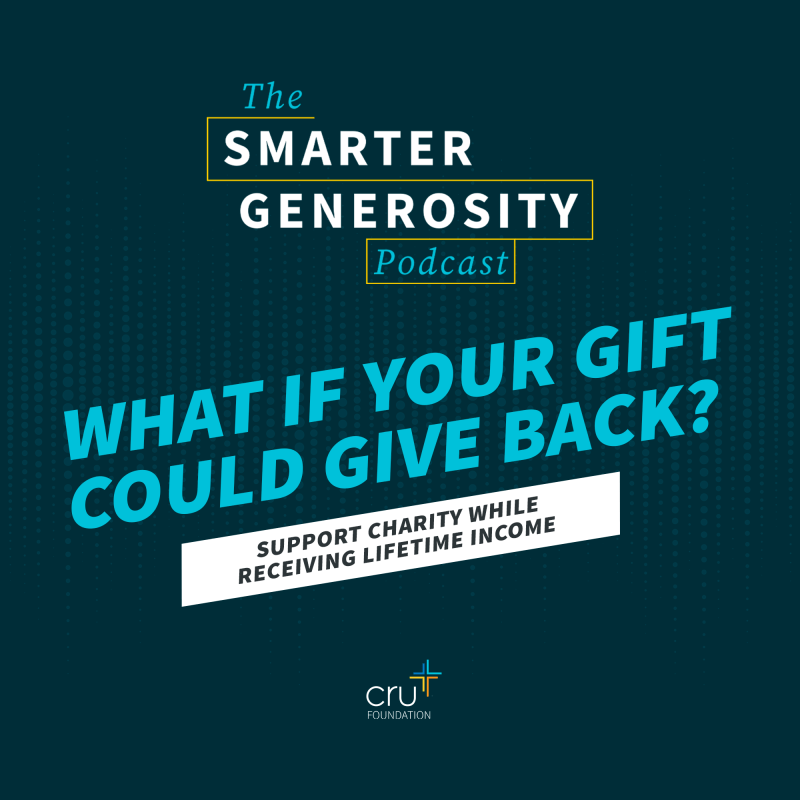


What If Your Gift Could Give Back?
Receiving Lifetime Income While Supporting Your Favorite Charities
What if you could make a meaningful charitable gift while also receiving a lifetime income stream?
In this episode, Eric Fleshood and Katie Brubaker explore charitable gift annuities (CGAs), how they work, and who they may be a good fit for. They discuss the difference between charitable and commercial annuities, immediate and deferred payments, payout rates, potential tax benefits, and how a CGA can combine generosity with predictable income.
A charitable gift annuity can offer a thoughtful way to meet financial needs while also creating a meaningful gift that supports the work God is doing through ministry.
New to gift annuities? Start by reading, What Is a Charitable Gift Annuity?
When you’re ready, request a gift annuity illustration for your situation. There’s no pressure, and you can talk it over with your advisor.
Note: This episode is for spiritual edification and educational purposes only and is not intended as legal or tax advice. Consult your professional adviser before making financial or charitable decisions.
For more information, visit our Charitable Gift Annuity page.
This content is provided for educational purposes only and should not be considered legal or tax advice. Please consult your professional advisor regarding your specific situation. Cru Foundation does not write charitable gift annuities in Arkansas, Hawaii, Maryland, New Jersey, New York or Washington.
What Is a Charitable Gift Annuity? Giving Generously While Receiving Lifetime Income
Katie Brubaker: Welcome back to the Smarter Generosity podcast. I’m Katie Brubaker.
Eric Fleshood: And I’m Eric Fleshood.
Katie: Have you ever thought, “I wish I could give more, but…”?
There are all kinds of ways to finish that sentence. And for some people, that’s where a charitable gift annuity can become part of the conversation.
Today, we’re going to talk about what a charitable gift annuity is, who it might be helpful for, and how it can provide a way to be generous while still meeting real financial needs.
Eric, let’s start with a simple definition. How would you describe a charitable gift annuity in just a sentence or two?
Eric: A charitable gift annuity is a gift to charity in exchange for lifetime income.
It’s a contract between a charitable organization and a donor, or annuitant, where the donor makes a gift and the charity agrees to provide an income stream for the lifetime of one or two designated people.
So there’s both a charitable gift component and an income component.
Katie: I feel like the word annuity sometimes has a bad reputation.
I remember a situation a year or two ago when someone called and left me a message saying she was interested in a charitable gift annuity and wanted to learn more.
I called her back, and we had a conversation. But afterward, her daughter called me and said, “Don’t call my mom again talking about annuities. If you need to talk with her, you have to go through me.”
I tried to explain that we weren’t talking about a commercial annuity. A charitable gift annuity is different.
So can you help us understand that distinction?
What’s the difference between a commercial annuity and a charitable gift annuity?
Eric: You’re bringing up one of the more challenging questions right at the beginning, Katie!
But I think it’s a good question because people hear the word annuity and naturally bring certain assumptions into the conversation.
Some financial professionals have concerns about commercial annuities, and those concerns can affect how people respond when they hear about charitable gift annuities.
But the first thing we need to understand is that a charitable gift annuity is not an investment.
When someone purchases a commercial annuity, they’re entering into a financial arrangement that’s designed around income and other financial objectives.
A charitable gift annuity is different because it begins with a charitable gift.
The donor is making a contribution to support a charitable organization, and in exchange, the organization agrees to provide specified payments for life.
That charitable purpose puts it in a different category.
Katie: So help me understand how it can be both.
You mentioned that someone makes a gift to a charity, but then they also receive payments from that gift.
Where does the charitable contribution come in?
Walk us through how that works.
Eric: A charitable gift annuity has two important purposes.
The first is to provide payments to the annuitant for life.
When the gift is established, the charity enters into a contractual obligation to make those payments.
The charitable organization manages the contributed assets and uses its available resources to fulfill that obligation.
But there’s also a charitable component.
A portion of the original contribution is considered a charitable gift, and after the annuity obligations have ended, the remaining funds are available to support the charitable organization’s mission.
So it serves two purposes.
During the annuitant’s lifetime, it provides income.
And once the lifetime payment obligation has ended, the remaining charitable resources can be used more fully for the ministry’s work.
That’s why I think charitable gift annuities are such a wonderful option for certain donors.
Katie: Who would you say this is most appropriate for?
It doesn’t sound like something everybody should necessarily pursue.
So paint a picture of someone who might find that a charitable gift annuity fits what they’re trying to accomplish.
Eric: One of the most common situations we see is someone who’s experiencing a change in income.
Often, that happens when a person is moving into retirement.
Maybe they’re leaving the workforce and beginning to live on retirement savings or other sources of fixed income.
That can cause people to reconsider their budgets.
They might begin thinking, “I’m going to need to reduce some of my expenses. Maybe I’ll need to reduce my charitable giving too.”
But they may not want to do that.
They want to continue supporting their church, the ministries they care about, and the work God has placed on their hearts.
Some may even want to increase their giving.
A charitable gift annuity creates another option.
It allows someone to make a meaningful charitable gift while also receiving lifetime payments that can help meet their financial needs.
It brings those two purposes together.
Katie: Let’s talk about something people are probably wondering as they’re listening: payout rates.
How are payout rates determined? And how might they compare with other income arrangements someone could consider?
Eric: Most charities that offer charitable gift annuities, including Cru Foundation, look to the American Council on Gift Annuities, or ACGA.
It’s an established nonprofit organization that publishes suggested charitable gift annuity payout rates.
Those suggested rates are designed to help charitable organizations balance their payment obligations with the charitable purpose of the gift.
Several factors affect the payout rate.
One is the age of the person receiving the payments.
Another is whether the annuity covers one life or two.
For example, a husband and wife might establish a charitable gift annuity that makes payments for both of their lifetimes.
When the first spouse passes away, the payments can continue for the lifetime of the surviving spouse.
That arrangement affects the payout rate.
Generally speaking, the older the annuitant is when payments begin, the higher the suggested payout rate tends to be.
For example, depending on the applicable ACGA schedule and the ages involved, two people around age 70 might receive a payout rate in the mid-5 percent range.
At older ages, those rates can be higher.
For a single-life arrangement, payout rates are generally higher than for a comparable two-life arrangement.
And at advanced ages, single-life payout rates can reach approximately 10 percent under certain schedules.
Of course, the specific rate depends on the terms of the gift and the rate schedule in effect when it’s established.
Katie: So, generally speaking, the older someone is, the higher their payout rate may be.
That raises another question.
Could I establish a charitable gift annuity now but wait several years before the payments begin?
Or do the payments have to start immediately?
Eric: That’s a great question.
A standard charitable gift annuity often begins making payments soon after the gift is established.
But there’s also something called a deferred charitable gift annuity.
That allows someone to make the charitable gift now and arrange for payments to begin at a later date.
And generally, the longer those payments are deferred, the higher the eventual payout rate may be.
So imagine someone who’s preparing for retirement but doesn’t expect to need that additional income for another five or ten years.
They may be able to establish the charitable gift annuity today, arrange for payments to begin later, and receive a higher payout rate when those payments start.
That can be an attractive option for someone who’s thinking ahead.
Katie: I can see how that could be helpful.
Let’s say my husband and I are thinking about making a significant charitable gift.
Maybe it’s $10,000, $20,000, or a larger amount.
We already know which ministry we want to support, and we’re thinking about what could become one of the largest charitable gifts we’ll make during our lifetime.
We could potentially establish that gift now, arrange for the payments to begin when we need them, and know that the remaining charitable resources will eventually support the ministry we’ve chosen.
Eric: That’s right.
And that raises another interesting question.
If you’re planning to make a significant charitable gift eventually, why not simply wait until the end of your life to make it?
One advantage of establishing a charitable gift annuity during your lifetime is that it may qualify for a partial charitable income tax deduction.
The deductible portion is calculated based on several factors, including the amount contributed, the payout arrangement, and the applicable tax rules.
So the donor may receive a charitable tax benefit in the year the gift is established, even though the charity also has a contractual obligation to make payments to the annuitant.
Katie: So the potential charitable deduction comes when the gift is established?
Eric: That’s generally correct, subject to the applicable rules and the donor’s tax situation.
Katie: What about the payments someone receives? How are those treated for tax purposes?
Eric: That’s another important feature.
The tax treatment of charitable gift annuity payments depends on several factors, including what assets were used to fund the gift.
In some cases, a portion of each payment may be treated as a tax-free return of principal.
Another portion may be taxable as ordinary income, and certain gifts funded with appreciated property can involve capital gains treatment as well.
That means the tax treatment can be different from what someone might expect from another income arrangement.
So when we’re comparing options, it’s important to look at the whole picture.
There’s the charitable deduction that may be available when the gift is established, the payout rate, and the tax treatment of the payments over time.
Katie: So someone considering a charitable gift annuity needs to look beyond the published payout rate.
They also need to understand how the charitable deduction and the taxation of the payments might affect their overall financial situation.
Another thing we’ve seen is that some people establish a charitable gift annuity because they need the income at that point in life.
But circumstances can change.
Sometimes, years later, they realize they no longer need those payments.
And we’ve seen people receive the payments and then turn around and give that money to charity.
Eric: That’s right.
It creates some interesting opportunities.
If someone receives annuity payments and decides they don’t need those funds for living expenses, they can consider making additional charitable gifts.
Depending on their circumstances, those additional contributions may qualify for charitable deductions.
There’s also another option that sometimes comes into play.
Someone may be several years into their charitable gift annuity and realize they no longer need the future payments.
In certain circumstances, they may be able to relinquish their right to those payments so the charity can use the resources for its charitable purposes sooner.
That kind of decision has its own tax and legal considerations, of course, but it’s another example of the flexibility that may be available.
There’s also a different kind of donor who finds charitable gift annuities attractive.
These are people who have reached a point in life where they’re less comfortable with the volatility of the stock market.
They’re looking for predictable payments that aren’t going up and down with the market.
Katie: Right. They’re looking for stability.
Eric: Exactly.
One of the distinctive features of a charitable gift annuity is that the payment amount is fixed under the agreement.
You know what the scheduled payments will be when you establish the gift.
And assuming the charity fulfills its contractual obligation, those payments remain the same over the life of the arrangement.
They’re not recalculated every year based on stock market performance.
That predictability can be reassuring for people who are thinking about their retirement income.
Katie: That’s a great point.
For someone who wants more predictability and doesn’t want every part of their income to fluctuate with the market, that could be an important consideration.
And we’ve also seen donors who really appreciate charitable gift annuities and establish more than one.
I know of people who have established 26 or 27 charitable gift annuities with Cru Foundation over time.
So this isn’t necessarily something someone can only do once.
They can establish multiple gift annuities, potentially with different charities, if that continues to make sense for their circumstances and charitable goals.
Eric: That’s right.
And we’ve seen that happen quite often.
Someone establishes their first charitable gift annuity, finds that it works well for them, and then decides to establish another.
Over time, they may create a series of charitable gift annuities.
Sometimes people refer to that as laddering.
They’re building charitable gifts into their financial planning while also addressing their income needs.
And I think that’s a wonderful example of how generosity and responsible financial planning can work together.
Katie: Another thing I want to mention is how the eventual charitable gift can be designated.
I can only speak specifically about Cru Foundation here, but when someone establishes a charitable gift annuity with us, they can identify particular ministries or purposes within Cru that they’d like the remaining charitable resources to support, subject to the terms of the gift agreement.
I think some people assume that whatever remains simply goes into a general fund.
But donors can often be much more intentional about the ministry work they want their gift to support.
And I know that’s an important consideration for many of the people we serve.
Eric, if someone has been listening and thinks, “This might be helpful for me,” or perhaps for somebody they know, what’s the first step?
Eric: I think the first step is finding a comfortable place to ask questions.
That’s what we try to provide at Cru Foundation.
We want people to feel that they can come to us, ask their questions, and receive clear explanations without pressure.
We can also prepare a personalized charitable gift annuity illustration based on their circumstances.
That might include their age, their spouse’s age if it’s a two-life arrangement, and whether they’re considering immediate or deferred payments.
We can help them understand what the payout arrangement might look like and what charitable deduction may be available.
There are also other options we haven’t had time to discuss today.
So I’d encourage someone who’s interested to contact Cru Foundation and ask for an illustration.
Then they can take that information to their professional advisors, discuss it, and make an informed decision about whether a charitable gift annuity is appropriate for them.
There’s no need to rush the conversation.
We want people to have the information they need to make a decision that reflects both their financial circumstances and their desire to be generous.
Katie: Thank you, Eric.
I appreciate you walking us through what a charitable gift annuity is, who it might be helpful for, and how someone can begin exploring whether it’s right for them.
I look forward to our next conversation.
Eric: It was great talking with you about this today, Katie. I look forward to our next conversation too.
Katie: Thanks, Eric. Bye.
This transcript has been edited for clarity and readability. Verbal fillers, repeated phrases, and recording interruptions have been removed.
This content is provided for educational purposes only and should not be considered legal or tax advice. Please consult your professional advisor regarding your specific situation.