
Donor-Advised Fund Tax Benefits: 3 Ways More Can Reach Ministry
Donor-advised fund tax benefits can help more reach Kingdom work and deepen the joy of faithful stewardship before God, while keeping tax savings in their proper place.
A family has held shares of stock for years, and those shares have grown considerably. They would like to support their church, two missionaries they know, and a ministry preparing for a fall campaign. Their desire to give is settled. What they are trying to understand is how to give the stock wisely.
The short answer is that a donor-advised fund offers three tax benefits: an immediate charitable deduction, no capital gains tax on appreciated assets given directly, and tax-free growth in the fund until grants are recommended.
Those benefits are subject to the donor’s situation and applicable IRS limits. A professional advisor can help determine how the rules apply to a particular gift.
For a broader introduction, begin with our guide to donor-advised funds or read more about how a donor-advised fund works.
Table of Contents
Before the mechanics: the tax-savings question
Many families feel a tension here. They want their giving to come from conviction rather than from a deduction, and they wonder whether considering the tax side makes the gift feel less spiritual. We take it up at length in our guide to the tax benefits of charitable giving: in short, wisdom can serve conviction once the decision to give has already been made.
Let’s assume you’ve already decided to give. Once that family decision has been made, what does a donor-advised fund specifically do with the tax code?
The tax benefits of a donor-advised fund
A donor-advised fund combines three charitable tax benefits in one giving structure:
- A potential charitable deduction in the year the contribution is made
- The potential to avoid capital gains tax by giving appreciated assets directly
- Tax-free growth inside the charitable fund before grants are recommended
An immediate charitable deduction the year you give
A contribution to a donor-advised fund is generally considered a completed charitable gift when the sponsoring organization receives the asset and assumes exclusive legal control. The donor may therefore be eligible for a charitable deduction in that tax year, subject to applicable limits, even when grants to individual ministries will be recommended over several years.
That separation can be helpful for a family holding appreciated stock or navigating a year of unusually high income. The family can make the charitable contribution while the asset is available, then take more time to decide where grants may do the most good.
The gift has already been made and set apart for charitable purposes. What remains is the opportunity to pray, learn, and recommend grants without forcing every ministry decision into the final weeks of the year.
You can still recommend grants and, depending on the sponsor, advise how the charitable balance is invested.
No capital gains tax on appreciated assets
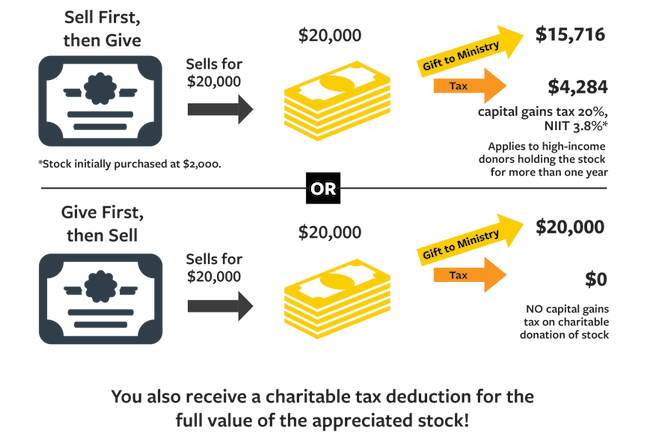
Imagine that same family still holds the appreciated stock. One approach would be to sell the shares, pay any resulting capital gains tax, and give the remaining cash.
Another approach is to contribute the shares directly to a donor-advised fund before a sale. The family may be eligible for a charitable deduction based on the stock’s fair market value, subject to applicable annual deduction limits. Separately, if the stock has been held for more than 12 months, contributing it directly allows the family to avoid capital gains tax when the charity liquidates the shares.
This is sometimes described as a double tax benefit: the charitable deduction and the avoided capital gains tax.
The donor-advised fund adds another practical advantage. A single contribution of stock can support multiple eligible charities. The family does not have to complete separate stock gift processes for a church, several missionaries, and other ministries, many of which are not set up to receive gifts of stock. The DAF streamlines the process by acting as a hub for stock processing and granting cash gifts.
Consider giving appreciated stock before automatically writing a check. This diversifies your options for giving by making more of your wealth donation relevant and easing the strain on cash flow. Many generous families experience a 10x in their giving because the DAFfrees them from the limitations of cash-only giving.
Tax-free growth inside the fund
After assets are contributed, the charitable balance may be invested according to the sponsoring organization’s available options and policies. Because the sponsoring organization owns the assets, investment growth accrues to the charitable fund tax free.
Markets can rise or fall, so growth is never promised, though very conservative options can be used. Still, the structure allows the full charitable balance to remain committed to generosity while the family considers future grants.
Suppose the family recommends grants to its church and missionaries soon after contributing the stock, then leaves part of the balance invested. Any future growth may increase what is available for another ministry opportunity. What has been given remains dedicated to charitable use; the family is no longer deciding whether to be generous with those resources, only where that generosity may bear fruit. This tax-free investment growth is another reason DAF users often experience a 10X in giving.
How much can you deduct?
A contribution to a donor-advised fund maintained by a public charity is subject to the charitable-deduction limits that apply to gifts to public charities.
Under current federal rules, cash contributions may be deductible up to 60% of adjusted gross income (AGI). Long-term appreciated securities maybe deductible at fair market value up to 30% of AGI. Cash and appreciated securities combined are limited to 50% of AGI. These figures are subject to the donor’s situation, the type of property, other charitable contributions, and applicable IRS rules.
When a contribution exceeds the applicable adjusted-gross-income limit, the unused portion may be carried forward for up to five additional tax years. The relevant percentage limit continues to apply during the carryforward period.
The IRS explains the current deduction limits in Publication 526. The general mechanics are also covered in our guide to the tax benefits of charitable giving.
Giving on your timing, not the calendar’s
Tax deadlines, asset appreciation, and ministry needs don’t always happen at the same time. A stock may appreciate significantly during the summer. A business transaction may close in October. A family may experience an unusually high-income year. Meanwhile, a church campaign or a missionary need may not become clear until much later. And then there’s the close of the tax year on December 31.
A donor-advised fund allows the charitable contribution and the grant recommendations to happen on different timelines. Some families contribute several years of budgeted generosity during one tax year, then recommend grants at their usual pace in the years that follow. This approach is called bunching.
How bunching may work over two years
| Traditional Annual Giving | Bunching through a DAF | |
| Year 1 charitable contribution | $15,000 | $30,000 |
| Year 1 other deductions | $13,000 | $13,000 |
| Year 1 total deductions claimed | $31,500 standard deduction | $43,000 itemized deductions |
| Year 2 charitable contribution | $15,000 | $0 |
| Year 2 other deductions | $13,000 | $13,000 |
| Year 2 deduction claimed | $32,200 standard deduction | $32,200 standard deduction |
| Total deductions over two years | $63,700 | $75,200 |
| Charitable donations over two years | $30,000 | $30,000 |
In this hypothetical example, bunching creates $11,500 in additional deductions over two years, while grants can continue at the family’s usual pace.
The tax benefit to bunching is that it may allow someone who doesn’t ordinarily itemize their deductions to be able to qualify for an itemized deduction in the bunching years which is a bigger savings than the standard deduction. The stewardship benefit is that the grant decisions can remain thoughtful. “The plans of the diligent lead surely to abundance, but everyone who is hasty comes only to poverty” (Proverbs 21:5, ESV). That verse is not a formula for tax planning, but it does remind us that diligence and haste are different postures. A family can set resources apart deliberately and still leave room for prayer. The calendar may determine when a contribution is completed, while discernment shapes how grants are directed.
What the 2025 tax law changed
The One Big Beautiful Bill Act became law in 2025. Several provisions affecting charitable deductions generally apply to tax years beginning after December 31, 2025.
First, itemized charitable deductions are now subject to a floor equal to 0.5% of adjusted gross income. In broad terms, charitable contributions become deductible only to the extent eligible contributions exceed that floor. The law includes detailed ordering and carryforward rules, so the effect will vary by taxpayer.
Second, the law limits the value of itemized deductions for taxpayers in the highest federal income-tax bracket. In some situations, this can effectively limit the federal tax value of an itemized deduction to roughly 35%, rather than the taxpayer’s 37% marginal rate.
Third, taxpayers who do not itemize may now qualify for a deduction of up to $1,000 for a single filer or $2,000 for a married couple filing jointly for certain cash contributions. Contributions made to establish or maintain a donor-advised fund are excluded from this particular non-itemizer deduction. That distinction is important, but it does not mean eligible contributions to a donor-advised fund are no longer deductible. They may still qualify as itemized charitable deductions, subject to the donor’s situation, the 0.5% floor, and other applicable limitations.
These provisions can be complex, but you do not have to sort through them alone. A Cru Foundation specialist can help explain how the rules relate to charitable giving, explore how they may affect a specific contribution, and work alongside your professional advisor as you consider your situation.
The tax break is the beginning, not the point
A donor-advised fund can make generosity more tax-efficient, and it can open room between the moment a family gives and the moment grants are recommended. Those are real benefits. But the fund itself cannot answer the questions that matter most: what God has entrusted to a family, what it is for, and where He is inviting them to respond. Those are worked out before the Lord, not on a tax form.
Paul told Timothy to encourage those who are rich in this present age “to do good, to be rich in good works, to be generous and ready to share, thus storing up treasure for themselves as a good foundation for the future” (1 Timothy 6:18-19, ESV). A donor-advised fund is one ordinary way to store up that kind of foundation: to set resources apart now, let them grow toward the harvest, and give them away with intention. The tax benefit is the beginning of that, not the end of it.
FAQ
Are donor-advised fund contributions tax-deductible?
Contributions to a donor-advised fund maintained by a qualified sponsoring charity may generally be eligible for a charitable deduction in the year the contribution is completed. The amount and usefulness of the deduction depend on the asset, applicable IRS limits, whether the donor itemizes, and the donor’s broader tax situation.
How much of a tax deduction do you get for a donor-advised fund?
The potential deduction generally depends on the type and value of the contributed asset. Cash contributions may generally be deductible up to 60% of adjusted gross income, while qualifying long-term appreciated securities may generally be deductible at fair market value up to 30%, subject to the donor’s circumstances and applicable IRS rules.
Does a donor-advised fund help you avoid capital gains tax?
Contributing a qualifying long-term appreciated asset directly to a donor-advised fund before it is sold generally prevents the donor from personally realizing capital gains on the appreciation. The donor may also be eligible for a deduction based on fair market value, subject to applicable limits and professional guidance.
Can you take the tax deduction now and give to charities later?
Yes. The potential deduction is tied to the year in which the contribution to the sponsoring charity is completed. The donor may then recommend grants to eligible charities over time, according to the sponsoring organization’s policies.
Did the 2025 tax law change donor-advised fund deductions?
The law made some slight changes to how all charitable donations work, including those to DAFs. Beginning in 2026 itemized charitable contributions are subject to a 0.5%-of-AGI floor, certain taxpayers in the highest bracket face an additional limitation, and the new deduction for non-itemizers excludes donor-advised fund contributions.
Are there any drawbacks to a donor-advised fund?
Contributions are irrevocable, and the sponsoring organization maintains exclusive legal control of the assets. Donors retain advisory privileges, although they cannot reclaim contributed assets for personal use. Before contributing, it can be helpful to understand the sponsor’s values, grant policies, eligible recipients, investment options, and fees.
When you’re ready
Perhaps you are holding appreciated stock, considering several years of generosity, or trying to understand how the new tax rules may affect a gift. You do not have to have every question answered. A Cru Foundation specialist can listen to what you hope to accomplish, help clarify the available giving options, and work alongside your professional advisors. The conversation can begin with what God has entrusted to you and what faithfulness may look like in this season.
crufoundation.org/contact · 800-449-5454 · hello@crufoundation.org
This content is provided for educational purposes only and should not be considered legal or tax advice. Please consult your professional advisor regarding your specific situation. Gifts to the Great Commission Donor Advised Fund are irrevocable and are under the exclusive legal control of Cru Foundation. AI tools were used as assistance in the creation of this content.